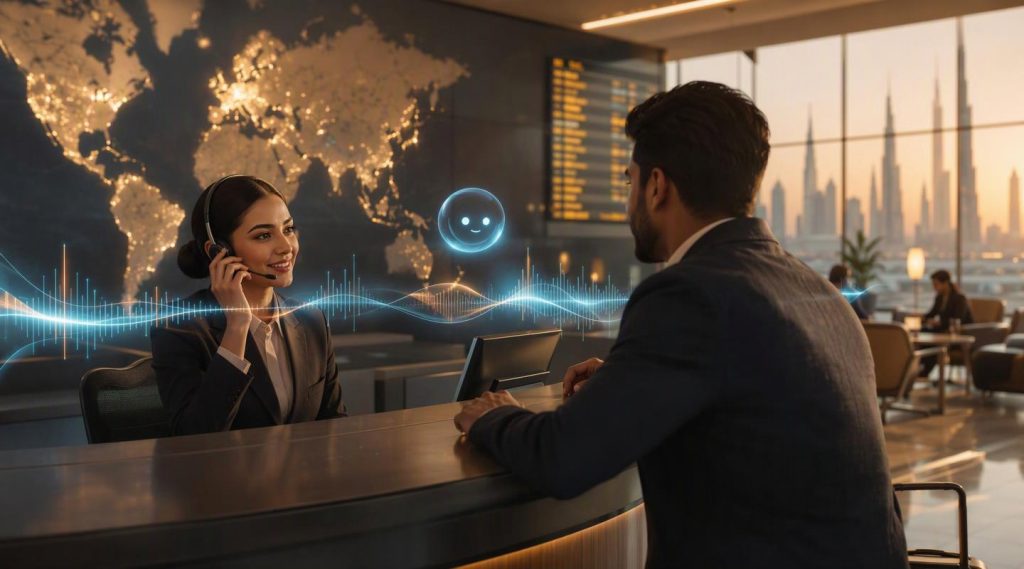
What is Agentic AI Implementation?
Agentic AI Implementation refers to the strategic deployment of agentic AI systems to automate and optimise specific business processes. These systems are designed to enhance operational efficiency, reduce costs, and improve outcomes by leveraging advanced technologies such as machine learning and natural language processing.
Want this for your business? Speak to the Eva team or message us on WhatsApp.
For businesses evaluating Agentic AI for customer service, the operational fit tends to be exact: voice is where the highest-intent conversations already happen. UAE operators considering Agentic AI for customer service typically start by auditing their current missed-call rate to size the opportunity. This helps to make sure that the AI solution addresses the most pressing operational challenges, such as high customer churn or inefficient service delivery.
How does Agentic AI automate staff training?
Agentic AI automates staff training by leveraging machine learning algorithms and natural language processing to create dynamic, personalised training modules. These systems can analyse individual employee performance, identify skill gaps, and tailor training content accordingly. For example, a restaurant in Jumeirah could use agentic AI to onboard new waitstaff by simulating customer interactions and providing instant feedback. Additionally, these systems can integrate with existing restaurant management software to track progress and support compliance with operational standards.
Where do UAE restaurants benefit most from Agentic AI?
- Onboarding Efficiency, Automating the onboarding process for new hires reduces time and supports consistency. Restaurants in Dubai Marina and JVC often face high turnover rates, making streamlined onboarding essential.
- Skill Development, Personalised training modules help staff master complex tasks faster. For example, restaurants in Business Bay can train staff to handle high-pressure lunch hours effectively.
- Compliance Training, Supports adherence to UAE food safety and hygiene regulations. Operators in Al Quoz, known for its industrial and food production hubs, benefit from AI systems that support compliance with local standards.
- Language Support, Multilingual training capabilities cater to Dubai’s diverse workforce. Restaurants in Sheikh Zayed Road, with their international clientele, often rely on this feature to bridge communication gaps.
- Performance Tracking, Continuous monitoring and feedback improve long-term employee performance. Restaurants in Jumeirah have reported higher staff retention rates due to the consistent feedback provided by AI systems.
Comparison: Traditional Training vs Agentic AI
Understanding the differences between traditional training methods and agentic AI-driven approaches highlights the transformative potential of AI in staff training.
| Aspect | Traditional Training | Agentic AI Training |
|---|---|---|
| Time Efficiency | Manual and time-consuming | Automated and scalable |
| Consistency | Varies by trainer | Standardised across modules |
| Personalisation | Limited | Highly tailored |
| Feedback | Delayed | Instant |
| Cost | Higher due to manual effort | Optimised over time |
Restaurants in Dubai Marina and DIFC have observed that agentic AI systems not only reduce training costs but also support a level of consistency that traditional methods struggle to achieve. This is particularly important in high-end dining establishments where service quality directly impacts customer loyalty.
Why voice matters in agentic AI for restaurants
Voice-first technology is a cornerstone of agentic AI systems, particularly in customer-facing industries like restaurants. Voice-enabled AI can simulate real-world scenarios, such as handling customer complaints or upselling menu items, during training sessions. This approach not only enhances communication skills but also prepares staff for high-pressure situations.
Restaurants in Dubai Marina, for instance, have reported improved customer satisfaction scores after implementing voice-first training modules. The ability to interact naturally with AI systems helps to make sure that staff are better equipped to deliver exceptional service. Operators in Jumeirah have noted that voice-enabled training helps bridge cultural and linguistic gaps, making it easier for staff to connect with a diverse customer base. This is especially valuable in Dubai’s multicultural environment, where effective communication can significantly enhance the dining experience.
Deploying Agentic AI in UAE restaurants
Deploying agentic AI in UAE restaurants involves several key steps. First, operators must identify specific training challenges, such as high turnover or inconsistent service quality. Next, they should select a solution like Eva.Agentic, which integrates seamlessly with existing systems to automate training processes. Implementation typically includes customising training modules to align with the restaurant’s brand and operational standards.
For example, a restaurant in DIFC might focus on training staff to deliver exceptional service to high-net-worth clientele, while a JVC-based restaurant might prioritise efficient onboarding to address frequent turnover. Collaboration with AI providers supports smooth deployment and ongoing optimisation.
Numbers and observations from industry deployments
Industry deployments commonly see significant improvements in training efficiency and employee performance. Restaurants using agentic AI report onboarding times reduced and skill retention rates improving substantially. Operators in Dubai’s hospitality sector frequently observe enhanced customer satisfaction as a direct result of better-trained staff.
For further insights, Agentic AI Dubai explores how loyalty programs benefit from AI. Additionally, Agentic AI for Healthcare offers a perspective on AI’s broader applications in service industries.
If you’re weighing this up, AI customer service automation UAE covers the practical detail worth knowing.
It’s worth reading AI consulting services Dubai alongside this, since the two connect directly.
Bottom Line
Agentic AI Implementation is revolutionising staff training processes for UAE restaurants, offering scalable, efficient, and personalised solutions. By adopting technologies like Agentic AI UAE, operators can help to make sure their teams are equipped to deliver exceptional service in a competitive market. Restaurants in Dubai Marina, Jumeirah, and Business Bay are already reaping the benefits, setting a benchmark for others to follow.
FAQ
How does agentic AI personalise training?
It uses machine learning to analyse individual performance, identify skill gaps, and customise training modules accordingly. This supports targeted skill development.
Can agentic AI handle multilingual training?
Yes, it supports multiple languages, making it ideal for Dubai’s diverse workforce. This feature helps bridge communication gaps effectively.
What is the deployment timeline?
Implementation typically takes 4-6 weeks, depending on the level of customisation required. Restaurants can start seeing results shortly after deployment.
Does agentic AI integrate with existing systems?
Yes, solutions like Eva.Agentic are designed for seamless integration with restaurant management software, supporting a smooth transition.
Sources

Hemant Agrawal is a subject matter expert in agentic AI and business automation at Eva. He writes on how organisations in the UAE apply autonomous AI agents to everyday commercial operations, from customer engagement to back office workflows.