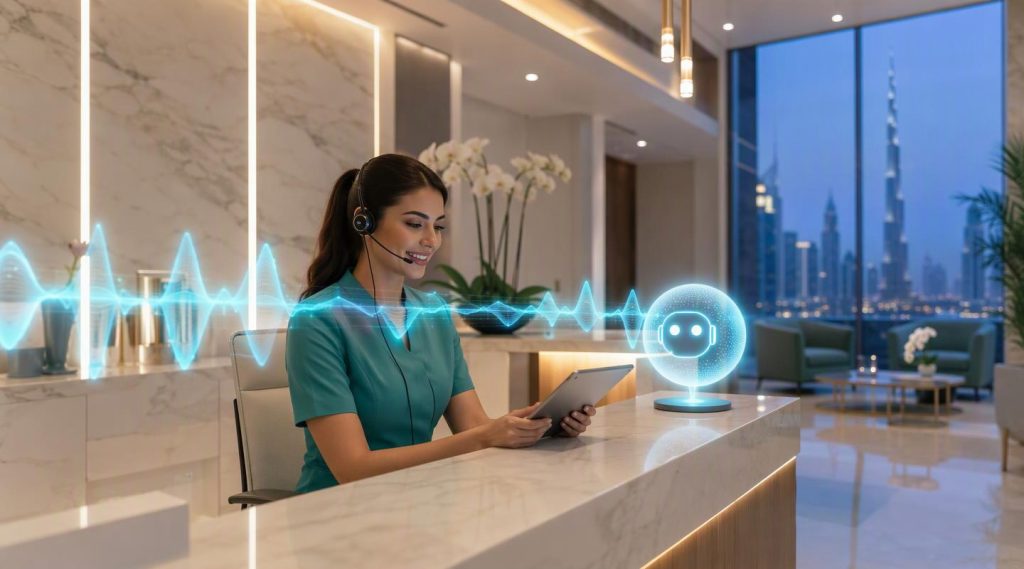
What is Agentic AI for Healthcare?
Agentic AI for Healthcare refers to the application of autonomous, voice-first artificial intelligence systems tailored to streamline operations in medical settings. These systems are designed to optimise workflows, reduce manual errors, and enhance patient experiences. In UAE clinics, where patient volumes can be high and operational efficiency is critical, Agentic AI solutions are increasingly deployed to automate repetitive tasks such as patient intake, appointment scheduling, and record management. By integrating with existing electronic health record (EHR) systems, these AI tools support seamless data flow and improved accuracy in patient handling.
Want this for your business? Speak to the Eva team or message us on WhatsApp.
For businesses evaluating AI for clinics, the operational fit tends to be exact: voice is where the highest-intent conversations already happen. UAE operators considering AI for clinics typically start by auditing their current missed-call rate to size the opportunity.
How does Agentic AI streamline patient intake processes?
Agentic AI systems automate several steps in the patient intake process, reducing bottlenecks and improving efficiency. For example, these systems can handle pre-appointment questionnaires via voice or text interfaces, helping to make sure that patient data is collected and verified before arrival. They also integrate with clinic management software to schedule appointments dynamically, minimising wait times. Additionally, Agentic AI can verify insurance details, reducing administrative delays. Operators in UAE clinics commonly report that these tools lead to faster patient onboarding and fewer errors in data entry, which are critical for maintaining high standards of care.
Where do UAE clinics benefit most from AI for patient intake?
UAE clinics benefit from Agentic AI in several key areas:
- Appointment Scheduling, Automates bookings and reduces double-booking errors.
- Data Collection, Captures patient information accurately before visits.
- Insurance Verification, Speeds up eligibility checks and reduces billing disputes.
- Queue Management, Dynamically adjusts schedules to minimise wait times.
- Follow-Up Coordination, Helps to make sure patients receive reminders for follow-up visits or tests.
These benefits are particularly impactful in high-traffic areas like Dubai Marina and Business Bay, where clinics often face operational challenges due to high patient volumes. For example, clinics in Dubai Marina have reported smoother patient flows during peak hours, while those in Business Bay have seen reductions in appointment no-shows thanks to automated reminders.
Comparison: Traditional Intake vs Agentic AI Systems
To understand the impact of Agentic AI, it is useful to compare traditional patient intake methods with AI-driven systems:
| Aspect | Traditional Intake | Agentic AI Systems |
|---|---|---|
| Data Entry | Manual, prone to errors | Automated, high accuracy |
| Appointment Scheduling | Staff-dependent, time-consuming | Dynamic, real-time adjustments |
| Insurance Verification | Manual checks, delays | Automated, instant validation |
| Queue Management | Static, inflexible | Dynamic, optimised |
| Patient Experience | Variable, dependent on staff | Consistent, AI-driven |
Why voice matters in healthcare AI
Voice-first AI systems are particularly valuable in healthcare settings due to their ability to provide hands-free, intuitive interactions. For instance, patients can use voice commands to book appointments or check their medical records, reducing the need for physical paperwork. Clinicians benefit from voice-enabled systems that allow them to update patient records or retrieve information without interrupting their workflow. Industry deployments typically report that voice-first systems improve accessibility for patients with disabilities and streamline operations in busy clinics. This is especially relevant in Dubai, where multilingual patient populations require adaptable and user-friendly solutions.
Deploying Agentic AI in UAE clinics
Deploying Agentic AI in UAE clinics involves integrating the technology with existing systems and workflows. Eva.Agentic, for instance, offers seamless integration with EHR platforms, enabling clinics to automate patient intake processes without disrupting operations. Clinics in DIFC and Jumeirah have successfully implemented these systems to reduce administrative burdens and enhance patient satisfaction. For example, a clinic in DIFC used Eva.Agentic to automate insurance verification, cutting processing times by half. Similarly, a Jumeirah-based clinic leveraged the system to manage multilingual patient interactions, improving communication and reducing errors. The deployment process typically includes customising the AI to align with clinic-specific needs, training staff to use the system effectively, and monitoring performance metrics to support continuous improvement.
Numbers and observations from the industry
Operators in the healthcare sector commonly see a 20-30% reduction in patient intake times after deploying Agentic AI systems. Clinics in Dubai Marina and Business Bay report improved patient satisfaction scores due to faster onboarding and reduced wait times.
It’s worth reading ai workflow automation services alongside this, since the two connect directly.
For a deeper dive, hire AI automation agency UAE unpacks how this plays out in day-to-day operations.
Bottom Line
Agentic AI for Healthcare is transforming patient intake processes in UAE clinics by automating key workflows and enhancing operational efficiency. Clinics adopting these systems benefit from faster onboarding, reduced errors, and improved patient experiences. To learn more about how these solutions can optimise your clinic’s operations, visit Agentic AI UAE.
Agentic AI for Healthcare is redefining patient intake processes across UAE clinics, delivering measurable improvements in efficiency and accuracy. By automating routine tasks such as data entry and appointment scheduling, these systems enable healthcare providers to focus on delivering quality care. Clinics in areas like Dubai Marina and Business Bay are already seeing enhanced patient satisfaction and streamlined operations.
Adopting agentic AI solutions not only reduces administrative burdens but also minimises errors that can impact patient outcomes. Industry deployments typically report faster onboarding times and more seamless integration with existing healthcare systems. For clinics aiming to stay competitive in the UAE’s dynamic healthcare sector, leveraging these technologies is a strategic step towards operational excellence and improved patient experiences.
FAQ
What is Agentic AI for Healthcare?
It is an AI system designed to optimise healthcare operations, including patient intake and record management. It integrates with electronic health record systems to support seamless data handling.
How does Agentic AI improve patient intake?
It automates data collection, appointment scheduling, and insurance verification, reducing errors and delays. Clinics in Dubai Marina and DIFC have reported faster onboarding and improved patient satisfaction.
Can Agentic AI integrate with existing clinic systems?
Yes, it integrates seamlessly with electronic health record platforms and clinic management software. The deployment process includes customisation and staff training to support smooth adoption.
Why is voice-first AI important in healthcare?
Voice systems enable hands-free interactions, improving accessibility and operational efficiency. They are particularly useful in multilingual environments like Dubai, where patient populations are diverse.
Sources

Gaurav Agrawal is a subject matter expert in agentic AI and business automation at Eva. He writes on practical deployments of AI agents across UAE industries, covering implementation, integration and measurable operational outcomes.